How Long Does a Fever Last With the Flu? Everything You Need to Know
Flu fever typically lasts 3 to 5 days in otherwise healthy adults and children. It tends to peak within the first 48 hours, then gradually breaks. But the timeline varies based on age, immune health, whether antiviral treatment was started early, and the specific influenza strain circulating that season. This guide covers the full fever timeline, what normal progression looks like, and the specific signs that mean your fever has crossed from uncomfortable into dangerous. If you are still unsure whether you have the flu, our overview of common flu symptoms in adults is a helpful starting point.

How Long Does Flu Fever Typically Last?
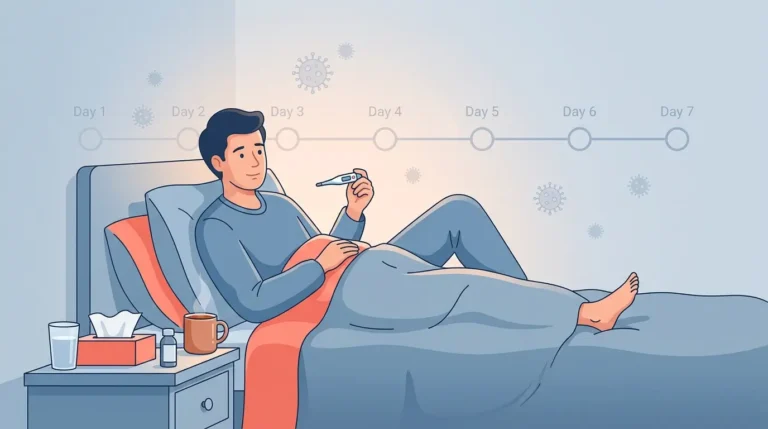
In a straightforward case of influenza, fever lasts between 3 and 5 days. Days 1 and 2 are usually the worst, with temperatures often reaching between 101 and 104 degrees Fahrenheit (38.3 to 40 Celsius). By day 3 or 4, most people begin to see the fever ease. By day 5, it is typically gone in healthy adults.
That said, the fever is often the first symptom to appear and the first to resolve. The cough, fatigue, and body aches can persist well past the point the fever breaks, which surprises many people. Feeling feverish is over. Feeling well is a different milestone entirely.
Clinical benchmark: A fever above 100.4 F (38 C) that persists beyond 5 days in an adult warrants medical evaluation. It may indicate a secondary bacterial infection or complication.
What Is the Day-by-Day Flu Fever Timeline?
Understanding the expected progression helps you distinguish normal illness from something requiring medical attention.
| Day | Fever Expectation | What Else to Expect |
| Day 1 | Onset. May spike rapidly to 101-104 F | Chills, body aches, headache begin |
| Day 2 | Peak fever. Often the most miserable day | Fatigue most severe, appetite gone |
| Day 3 | Fever may fluctuate. Some see first dip | Aches begin easing slightly |
| Day 4 | Fever declining in most healthy adults | Cough may worsen as fever drops |
| Day 5 | Fever typically resolved or very low grade | Congestion and cough remain |
| Day 6-10 | No fever in uncomplicated cases | Fatigue and cough persist |
| Day 10+ | Fever at this stage is a red flag | Evaluate for complications |
Does Flu Fever Last Longer in Children?
Yes, often. Children’s immune systems respond more aggressively to influenza, which produces more intense and sometimes longer-lasting fevers. Children under 5, especially those under 2, are at the highest risk of prolonged fever and complications.

What Is Normal for Children?
A fever of 103 to 104 F for the first 2 to 3 days is common in young children with influenza and does not automatically signal a complication. The trajectory matters more than the peak number. A fever that spikes hard and then begins trending downward by day 3 is reassuring. A fever that stays flat or climbs after day 3 is not.
Febrile seizures, brief convulsions triggered by rapid temperature changes, occur in roughly 2 to 5 percent of children between 6 months and 5 years old. They are frightening to witness but are not, by themselves, a sign of brain damage or long-term harm. However, any seizure warrants immediate medical evaluation.
What Is Normal for Infants Under 3 Months?
Any fever in an infant under 3 months old is a medical emergency, regardless of cause. Take them to the emergency room immediately. Do not wait to see if it resolves.
Does Flu Fever Last Longer in Older Adults?
This is where things get counterintuitive. Older adults, generally those over 65, often run lower fevers with influenza, not higher ones. Age-related immune changes reduce the intensity of the fever response. A 70-year-old with influenza might have a temperature of only 99.5 F while experiencing a severe illness.
The danger is that caregivers and patients themselves may underestimate how sick the person is because the fever does not look impressive. Clinicians use the term “blunted fever response” to describe this. If an older adult develops sudden fatigue, confusion, loss of appetite, or shortness of breath during flu season, treat it as a serious illness even if their temperature is only mildly elevated.
Duration-wise, fever in older adults may be shorter but the recovery period is longer. Full functional recovery from influenza in adults over 65 can take 3 to 4 weeks even after the fever resolves.
Does Taking Antiviral Medication Shorten Flu Fever?
Yes, meaningfully so. Oseltamivir (Tamiflu) and baloxavir marboxil (Xofluza) both reduce the duration of influenza illness, including fever, when started within 48 hours of symptom onset.
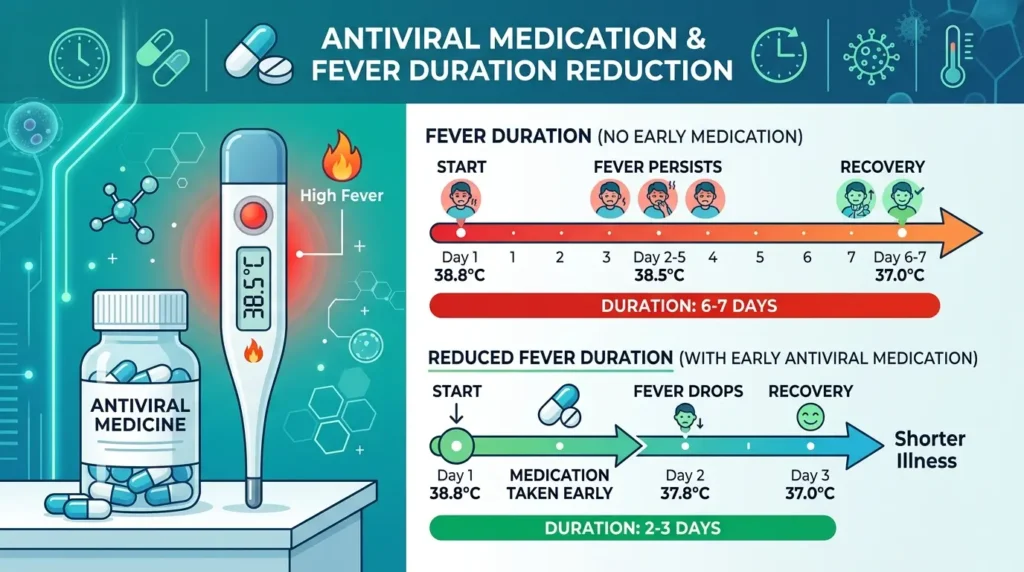
Studies published in the journal Clinical Infectious Diseases show that early oseltamivir treatment reduces fever duration by approximately 1 to 1.5 days compared to no treatment. That may sound modest, but for someone with a high-risk condition or caring for young children, shortening the fever period and reducing viral shedding matters.
The 48-Hour Window Matters More Than Most People Realize
Here is where people lose the benefit. Many patients wait 2 to 3 days before calling their doctor, by which point the antiviral window has closed. The medication is still prescribed sometimes but its fever-reducing and complication-preventing benefit is substantially lower after 48 hours.
If you are in a high-risk group (over 65, pregnant, immunocompromised, or have chronic heart or lung disease), book an online flu consultation the day symptoms start. Do not adopt a wait-and-see approach. The window is narrow.
Xofluza (baloxavir), approved in the US and Japan, requires only a single dose versus the 5-day twice-daily course of Tamiflu. For patients who struggle with medication adherence, this is a meaningful practical advantage.
What Does It Mean If the Fever Goes Away and Then Comes Back?
A returning fever after a period of improvement is one of the most important warning signs in influenza illness. It has a name in clinical medicine: biphasic fever pattern. And it frequently signals a secondary bacterial infection.
The most common cause is bacterial pneumonia, often from Streptococcus pneumoniae or Staphylococcus aureus, which colonizes the airways after the influenza virus has damaged the respiratory epithelium. The flu weakens your defenses; bacteria take advantage of the opening.
If you felt like you were improving on day 4 or 5 and then develop a new fever, worsening cough, or chest pain on day 6 or 7, seek medical care the same day. This pattern is responsible for a significant proportion of flu-related hospitalizations and deaths. It is treatable if caught early.
Flu Genie’s online flu consultation connects you with a licensed provider within minutes, which matters when the returning fever window is narrow.
Other Causes of a Returning Fever
- Sinusitis develops as a secondary infection
- Ear infection is particularly common in children
- Inadequate rest or returning to activity too soon, which can briefly re-elevate temperature
- Less commonly, influenza-associated myocarditis or encephalitis
How High Is Too High? Understanding Dangerous Fever Thresholds
Fever intensity matters, but context matters more. A 104 F fever in a healthy 30-year-old who is alert, drinking fluids, and responding to acetaminophen is clinically different from a 102 F fever in a 72-year-old who is confused and not drinking.
General Fever Thresholds by Age Group
| Age Group | Seek Immediate Care | Monitor Closely | Likely Safe to Manage at Home |
| Under 3 months | Any fever | N/A | N/A |
| 3-36 months | Above 104 F or lasting 2+ days | 102-104 F | Below 102 F with normal behavior |
| Children 3-17 | Above 104 F or lasting 5+ days | 103-104 F | Below 103 F, alert and drinking |
| Adults 18-64 | Above 104 F or lasting 5+ days | 103-104 F | Below 103 F, responsive to medication |
| Adults 65+ | Any fever with confusion or breathing changes | Any persistent fever | Low-grade with medical guidance |
Should You Treat a Flu Fever or Let It Run?
This is a question with a more nuanced answer than most health sites give. Fever is not just a symptom. It is an immune mechanism. Elevated body temperature inhibits viral replication, enhances immune cell activity, and accelerates the inflammatory response that clears the infection.
Some researchers argue that aggressively suppressing fever with antipyretics (fever reducers) may slightly prolong illness by removing a tool your immune system is actively using. A 2014 study in Proceedings of the Royal Society B found that fever suppression in influenza-infected animals resulted in approximately 5 percent higher mortality.
The practical takeaway for healthy adults: tolerating a moderate fever (100 to 102 F) without immediately reaching for medication is reasonable and may support faster recovery. Treating aggressively when the fever is above 103 F, causing significant discomfort, or preventing sleep and hydration is equally reasonable.
When You Should Always Treat the Fever
- In children under 5 with a history of febrile seizures
- When the fever is above 103 F and not responding to fluids
- When the person is unable to sleep or maintain hydration because of discomfort
- In anyone with heart disease, a sustained elevated heart rate from fever creates additional strain
- In pregnant women, a high fever in the first trimester carries the risk of fetal complications
Medication Options
Acetaminophen (Tylenol) and ibuprofen (Advil, Motrin) are both effective at reducing fever. Ibuprofen tends to work slightly longer, but acetaminophen is preferred for people with stomach sensitivity, kidney concerns, or who are taking blood thinners. Never give aspirin to children or teenagers with influenza due to the risk of Reye syndrome.
How Do You Know When the Fever Is Truly Gone?
This question matters practically because returning to work, school, or normal activity too soon is a common mistake that prolongs recovery and spreads influenza to others.
The CDC standard: you should remain home until you have been fever-free for at least 24 hours without using fever-reducing medication. The medication is the key qualifier. If your temperature is normal only because you took ibuprofen two hours ago, you are not fever-free. You are medicated.
Take your temperature before any dose of antipyretic. If it is normal at that point, that is a more reliable reading. If it is normal 24 hours after your last dose, you can reasonably consider yourself fever-free.
A practical home tip: measure your temperature at the same time each day, ideally in the morning before getting out of bed and before any medication. This gives you a consistent baseline to track the fever trend rather than isolated readings that can look misleadingly normal or high depending on timing.
Flu Fever During Pregnancy: A Separate Conversation
Pregnancy changes the influenza risk profile significantly, and fever management in pregnancy deserves direct attention rather than a footnote.
Pregnant women are at higher risk of severe influenza complications, including preterm labor and fetal distress associated with sustained high fever. The CDC and ACOG both recommend prompt antiviral treatment with oseltamivir for pregnant women with confirmed or suspected influenza, regardless of trimester.
Sustained fever above 101 F in the first trimester has been associated in some studies with neural tube defects and other fetal complications. Aggressive fever management with acetaminophen is recommended in pregnancy. Ibuprofen is generally avoided, particularly after 20 weeks.
If you are pregnant and develop symptoms consistent with influenza, do not wait for a positive test result to call your OB or midwife. Treatment decisions in pregnancy are made on clinical suspicion, not test confirmation, precisely because the stakes are higher and the antiviral window is narrow.
When to Call a Doctor About Flu Fever
Most flu fevers do not require a clinic visit. They require rest, fluids, and monitoring. But the following situations warrant a call or visit the same day.
Call Your Doctor If
- Fever exceeds 104 F in an adult or 103 F in a child over 3 and does not respond to medication within 1 to 2 hours
- Fever has lasted more than 5 days in an adult or more than 3 days in a child without improvement
- Fever returns after a period of apparent improvement
- Fever is accompanied by difficulty breathing, chest pain, or confusion
- You are pregnant, over 65, immunocompromised, or have chronic heart, lung, or kidney disease
- An infant under 3 months has any fever at all
- A child is inconsolable, has a stiff neck, a non-blanching rash, or sensitivity to light, alongside fever
If in doubt, call. Nurse triage lines at most health systems can help you decide whether your situation requires an in-person visit or can be managed at home with guidance.
The Bottom Line on Flu Fever Duration
A fever lasting 3 to 5 days is normal. It peaks hard in the first 48 hours and gradually resolves. Children may run longer or higher fevers. Older adults may run unexpectedly low ones. The returning fever pattern after improvement is the warning sign that most often leads to avoidable complications.
Fever management is not one-size-fits-all. Moderate fever in a healthy adult may be worth tolerating. Fever in a pregnant woman, infant, or older adult with confusion requires prompt action. And no matter your age or health status, if a fever goes beyond 5 days or returns after breaking, that is the signal to call your doctor.
The goal is not to eliminate fever the moment it appears. The goal is to monitor it intelligently, support recovery with rest and fluids, and recognize the patterns that cross from expected into urgent.
Frequently Asked Questions
Can you have the flu without a fever?
Yes. Approximately 10 to 30 percent of people with confirmed influenza do not develop a significant fever, particularly older adults with blunted immune responses. Absence of fever does not rule out flu.
Does a higher fever mean a worse case of flu?
Not necessarily. Fever intensity reflects immune response, not directly disease severity. Some people with mild flu run high fevers. Some with serious illness run low ones. Clinical status, including breathing, hydration, and mental clarity, is a better indicator of severity than temperature alone.
Why do I feel worse at night with flu fever?
Fever naturally rises in the evening due to circadian rhythms in immune activity and body temperature regulation. Cortisol, which has anti-inflammatory properties, is lowest at night, allowing fever to climb. This is normal and does not indicate worsening illness.
Can you get a flu fever twice in one season?
Yes. Different influenza strains circulate simultaneously. Infection with H1N1 does not protect against H3N2. It is uncommon but possible to have two distinct influenza infections in one season. Read more about this in our article on getting the flu back to back.
Does the flu vaccine prevent fever?
The vaccine does not prevent infection entirely in all cases, but vaccinated individuals who do get influenza typically have shorter, lower-grade fevers and significantly reduced risk of complications and hospitalization.
Is it normal to feel cold when you have a fever?
Yes. Chills occur because your body is raising its internal thermostat. Your muscles shiver to generate heat and reach the new set point. Once the fever peaks and your body begins cooling down, you feel hot and may sweat. Both phases are normal parts of the fever cycle.
How do I bring down a high flu fever fast?
Take a weight-appropriate dose of acetaminophen or ibuprofen, drink cool fluids, apply a damp lukewarm cloth to the forehead, and rest in a cool room. Avoid ice baths or alcohol rubs, which can cause shivering and raise core temperature. Fever reducers typically lower temperature by 1 to 2 degrees within 30 to 60 minutes.